
Introduction
Rslib is a library development tool based on Rsbuild.
It gives developers a simple way to create JavaScript libraries and UI component libraries, and provides tool integrations and best practices for building, debugging, documentation, and testing throughout library development.
Why Rslib
During the development of component or utility libraries, developers need to focus not only on implementing project logic, but also on handling tasks that are separate from the code itself, such as building, debugging, documentation, and testing. Although many community tools and solutions can address some of these needs, developers who are not familiar with them often face cumbersome configuration requirements or need to coordinate multiple tools to meet these demands.
Based on Rspack and Rsbuild, Rslib offers a comprehensive solution tailored to the diverse requirements of library development, effectively addressing issues such as incomplete tool ecosystems, high costs for module standard compatibility, and insufficient output optimization. Rslib optimizes webpack's limited support for library ESM outputs, reducing redundant runtime code and generating high-quality ESM outputs that are tree-shaking friendly for library consumers. Additionally, Rslib fully leverages the build performance advantages of Rspack and capitalizes the strengths of both the webpack and Rspack ecosystems to robustly support features such as Module Federation.
Furthermore, Rslib utilizes Rsbuild's out-of-the-box configuration to facilitate configuration sharing between application and library projects, resolving the challenge of reusing build configurations between application projects and library projects, thereby reducing the configuration overhead for developers and improving development efficiency and experience.
In the future, Rslib will explore additional possibilities by leveraging the new features of Rspack.
Features
Rslib has the following features:
-
Easy to configure: Out-of-the-box tooling enables developers to build libraries with zero configuration. Rslib also provides a set of semantic build configurations that can be extended as project needs grow.
-
Performance-focused: Powered by Rspack, it integrates high-performance Rust-based tools from the community, including SWC and Lightning CSS, delivering first-class build speed and development experience.
-
Plugin ecosystem: Supports Rsbuild plugins, Rspack plugins, and webpack plugins, allowing developers to reuse existing plugin ecosystems and continue using familiar development workflows and engineering practices.
-
Flexible outputs: Designed around the diverse ways libraries are published and consumed, it supports flexible build output configuration for different runtimes, distribution methods, and downstream build tools to meet the delivery needs of different types of libraries.
-
Framework agnostic: Decoupled from frontend UI frameworks, it supports React, Vue, Svelte, Solid, and other frameworks through plugins, allowing developers to build component libraries for different frameworks with a consistent configuration and development workflow.
Rstack
Rslib is part of Rstack, the fast, unified JavaScript toolchain for developers and agents.
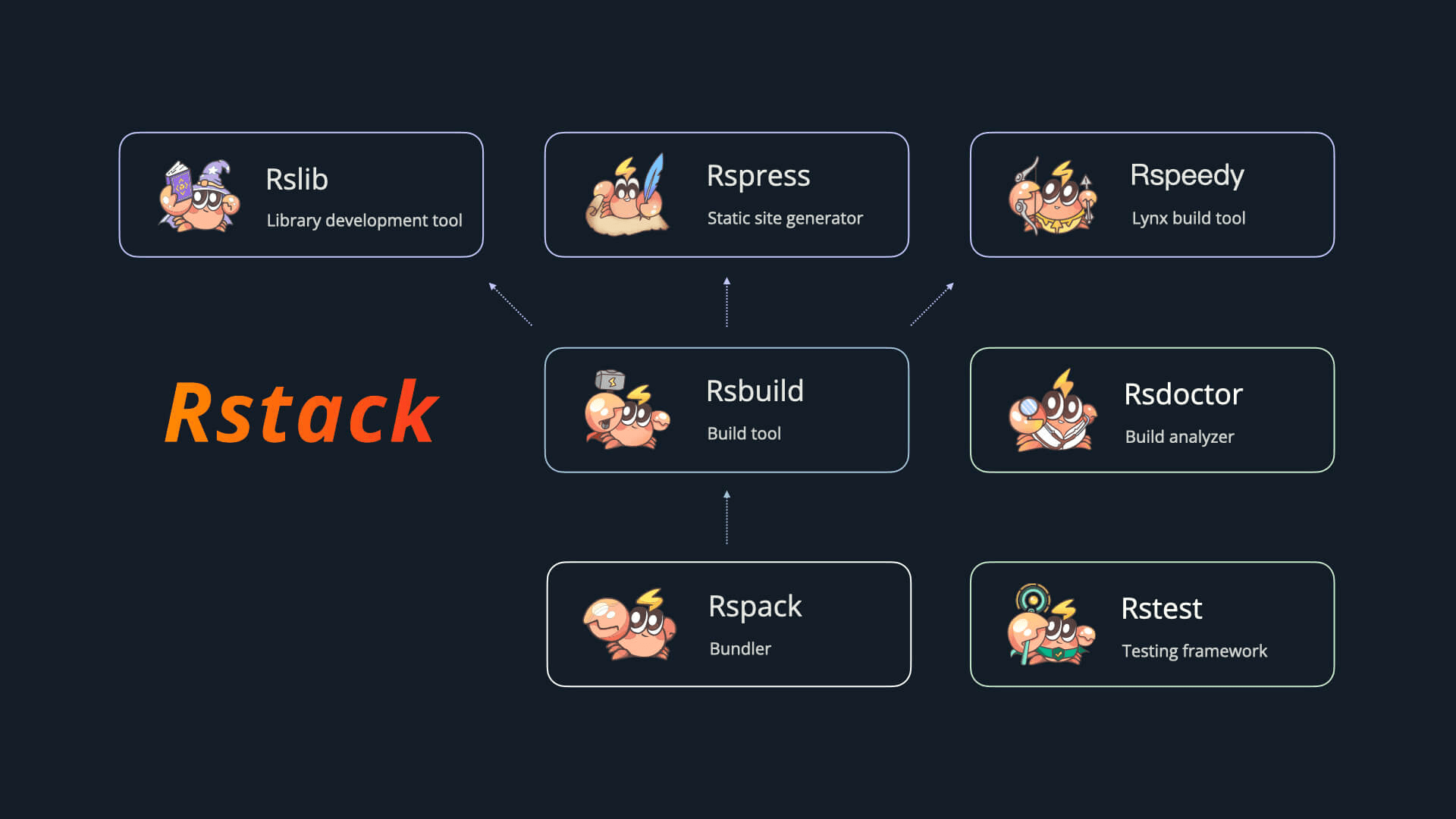
Rstack includes the following tools:
| Name | Description | Version |
|---|---|---|
| Rspack | Bundler |  |
| Rsbuild | Build tool |  |
| Rslib | Library development tool |  |
| Rspress | Static site generator |  |
| Rsdoctor | Build analyzer |  |
| Rstest | Testing framework |  |
| Rslint | Linter |  |
Links
- awesome-rstack: A curated list of awesome things related to Rstack.
- agent-skills: A collection of Agent Skills for Rstack.
- rstack-examples: Examples showcasing Rstack tools.
- storybook-rsbuild: Storybook builder powered by Rsbuild.
- rsbuild-plugin-template: Use this template to create your own Rsbuild plugin.
- rstack-design-resources: Design resources for Rstack.
Community
Come and chat with us on Discord! The Rstack team and users are active there, and we're always looking for contributions.
Online example
Try Rslib online with the StackBlitz example.
Next steps
Please read Quick start to start using Rslib.